
If you’ve never hired a long-distance mover before, the number of options can feel overwhelming. A quick search turns up dozens of companies, all promising the lowest price and the smoothest move.
Some of those promises are real. Others aren’t. The difference isn’t always obvious.
The problem is that most people don’t move long distance more than once or twice in their lives, so they don’t know the warning signs to look for. That means they could easily miss out on a solid company and instead choose one that will leave them stranded on their move date.
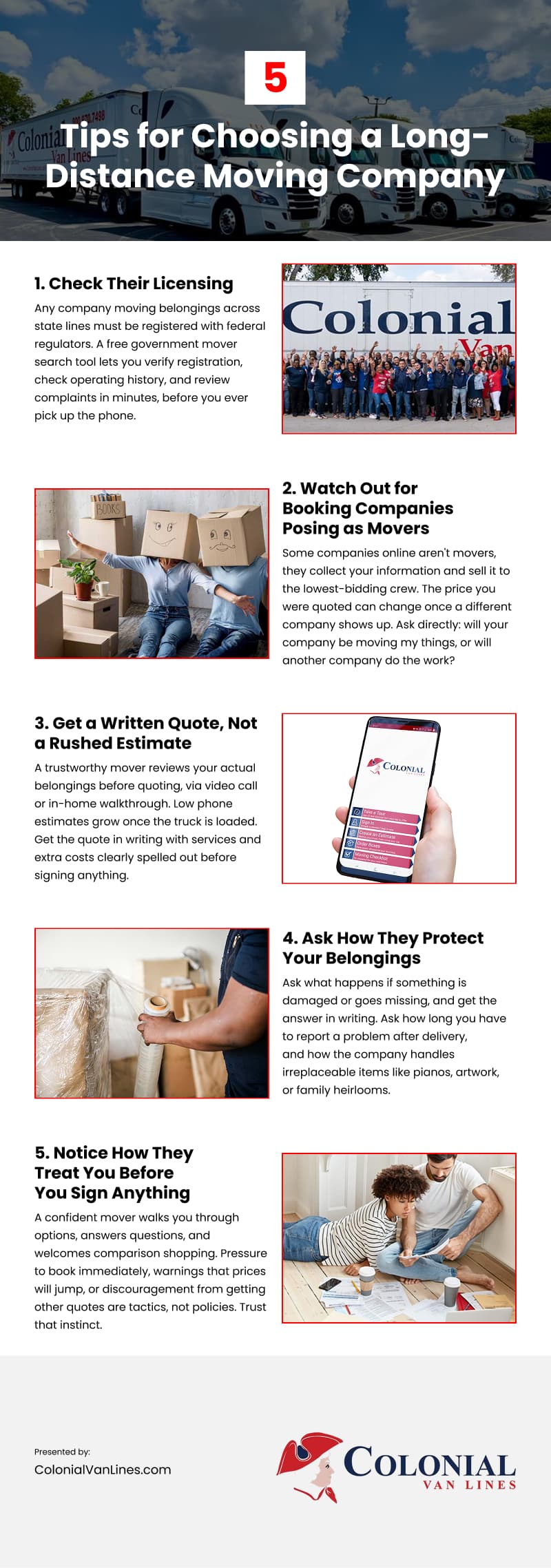
Knowing how to choose a long-distance moving company comes down to asking the right questions before you sign anything, not after. Here are five items to check off when choosing an interstate moving company.
1. Check Their Licensing
Any company that moves belongings across state lines has to be registered with federal regulators. This is the difference between a company that answers for its work and one that can disappear if something goes wrong, change its name, and reopen under a different one the following year.
You can look up a moving company’s registration through the federal government’s free online mover search tool before you ever pick up the phone.1 It only takes a few minutes and tells you whether the company is legitimate, how long it has operated, and whether complaints have been filed against it.
A company with nothing to hide won’t mind if you check. Many reputable movers will even point you to the tool themselves.
2. Watch Out for Booking Companies Posing as Movers
Some of the companies you find online aren’t movers at all. They’re booking services that collect your information and sell it to whichever moving company bids the lowest for your job that day.
That means you may never meet the actual crew that shows up. Additionally, the price you were quoted can change once the booking company is out of the picture and a different crew is standing in your driveway.
This is where a lot of moving horror stories start. A family books what looks like a full-service move. Then they find out a week before moving day that their job was handed off to a company they never spoke with at a price that no longer matches what they agreed to. By then, options are limited and stress is high.
A truly professional long-distance moving company either operates its own trucks and crews or is upfront about who will actually be doing the work. Ask directly: will your company be moving my things, or will another company be doing the work? If the answer is vague, treat that as a warning sign.
3. Get a Written Quote, Not a Rushed Estimate
A trustworthy mover wants to see what you actually own before giving you a price. That usually means a video call or an in-home walkthrough where someone reviews your furniture, boxes, and any large or unusual items.
A quote based on a five-minute phone call and a rough guess at your square footage is rarely accurate, and low estimates like that have a way of growing once the truck is already loaded.
Once you have a quote, get it in writing. A quote from a reputable moving company should clearly spell out what’s included. Those can be services such as packing materials, disassembly, and loading. It should also explain what would cost extra.
If a company will only give you a number verbally, ask why. A company confident in its pricing has no reason to avoid putting it on paper.
4. Ask How They Protect Your Belongings
Every mover is required to offer some level of protection for your things during transit, but the amount of coverage and the process for filing a claim can vary quite a bit.
Ask what happens if something is damaged or goes missing, and get the answer in writing rather than a verbal promise. Also ask how long you have after delivery to report a problem, since that window is shorter than most people expect.
If you own items that would be difficult or impossible to replace, ask specifically how the company handles those. These items might include a piano, artwork, or family heirlooms.
A mover with real experience will have a clear answer, often involving custom crating or extra padding, rather than a generic response about wrapping everything the same way regardless of what it is.
5. Notice How They Treat You Before You Sign Anything
Pay attention to how a sales representative talks to you during the quote process. A company confident in its work will walk you through your options, answer your questions, and give you time to compare quotes.
On the other hand, watch out for a company that pressures you to book immediately, warns that prices will jump if you wait, or discourages you from getting other quotes. These companies lead with fear instead of information.
That kind of pressure is a tactic, not a policy. A representative who genuinely wants to earn your business will welcome your questions instead of rushing past them.
Choosing a mover should feel like getting advice from someone knowledgeable, not like being pushed toward a decision. Trust that instinct. It’s usually right.
Making a Confident Choice
Choosing the right moving company takes a little research, but it doesn’t have to take long. Confirm the license, ask who is actually doing the work, get everything in writing, and pay attention to how you’re treated along the way. Each of these steps takes only a few minutes, and together they help you find the best long-distance moving company for your needs.
1https://www.fmcsa.dot.gov/protect-your-move/search-mover
Video
Infographic
Choosing a long-distance moving company is a decision most people only make once or twice, which means the warning signs are easy to miss without knowing what to look for. Explore tips for choosing a long-distance moving company in this infographic.