
Some of the hardest things to replace after a move aren’t necessarily the most expensive. It might be the set of dishes you inherited from your grandmother, a favorite lamp you’ve owned for years, or the antique wine glasses you only use on special occasions. When something fragile breaks during a cross-country move, the loss can be heartbreaking.
Moving across the country doesn’t always have to lead to broken belongings. Keeping them safe comes down to packing them in the right way and with the right materials. Instead of wrapping everything in an old towel and hoping for the best, you can get a far better result by using the right techniques and trusting interstate movers and packers to get the job done right.
Choose the Right Boxes and Materials
Buy dish-pack boxes or cell boxes for glassware, stemware, and other breakables instead of reusing whatever boxes you have on hand. These boxes use thicker cardboard and built-in dividers that plain moving boxes don’t have. That extra structure is vital on a long-distance haul.
Use clean packing paper instead of newspaper for anything you plan to use again. Newsprint ink rubs off on dishes, glass, and light-colored fabric. Getting it off later is its own project. Packing paper costs a little more, but saves you the additional cleanup when you get home.
Keep the weight of each box manageable, even if the box itself is sturdy. A box of dishes should stay light enough for one person to lift comfortably. You don’t want to risk a box being dropped because it was overfilled.
Match box size to weight, not just to what fits. Small and medium boxes work better than large ones for dense, breakable items like glassware and dishes. Remember, a large box packed full of dishes quickly becomes too heavy to lift safely, no matter how well you’ve wrapped the items inside.
Wrap Dishes, Glassware, and Kitchen Items the Right Way
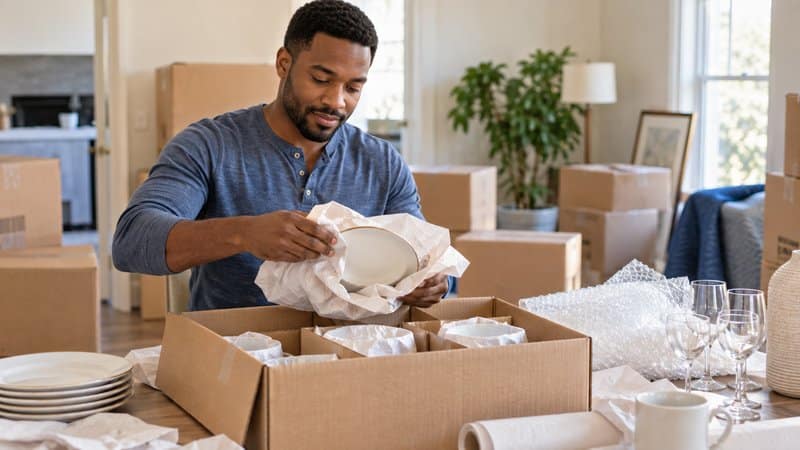
Start every box with a few inches of crumpled packing paper at the bottom. That cushion absorbs shock so that it can’t reach your dishes. This is the step most people skip, especially when they’re in a hurry.
Wrap each dish, glass, or bowl individually, not as a stack. Wrapping them individually allows them to shift and settle without grinding against bare glass or ceramic, which is usually what causes chips and cracks.
Pack plates on their edge, like records in a crate, instead of flat in a stack. Plates are strongest along their edge and weakest across their flat center. Packing them this way means they’re much less likely to break.
Nest glasses and cups with paper between each one, and fill any hollow space with crumpled paper before you close the box. A box that can’t shift inside survives a long car ride far better than one with room to move.
Wrap stemware by the bowl first, then wrap the stem separately before you box it. The stem is the thinnest, weakest part of a wine glass or a champagne flute. It needs its own layer of cushioning instead of relying on the wrap around the rest of the glass.
Protect Mirrors, Framed Art, and Glass Tabletops
Use mirror or picture boxes for anything flat and glass. These boxes are built specifically to keep flat, fragile items upright and separated from everything else on the truck.
Add corner protectors to framed art and mirrors before boxing them. Corners take the brunt of an impact far more often than the center of a flat surface. A few dollars of foam corners prevents the most common kind of damage.
Mark glass tabletops and mirrors clearly on both sides so your movers know to handle and load them carefully. A flat box doesn’t look like anything special from the outside, but simply adding a piece of tape and the word “glass” is a small step to ensure it’s handled with care.
Handle Lamps, Collectibles, and Odd-Shaped Items
Remove lampshades and light bulbs before you pack a lamp, and wrap the shade separately in its own box. Lampshades only hold their shape under the right pressure, and one heavy item resting against a shade is enough to crush it out of shape permanently.
Give collectibles and irregularly shaped items more cushioning than you think they need. A ceramic figurine or a curved vase doesn’t sit flat against packing paper the way a plate does, so it needs paper packed into every gap rather than just wrapped around the outside.
Keep fragile collections together in smaller, well-padded boxes instead of combining them with heavier household items. That way, professional interstate movers can identify and handle these boxes differently from one that mixes glass ornaments with cast iron pans.
Pack holiday ornaments and other seasonal decor with the same care as everyday glassware, not as an afterthought at the bottom of a closet box. These items often get stored for months at a time, so you might not even notice any damage from a long-distance move until the next time you unpack them. By that point, there’s no longer any way to trace what went wrong.
Label and Load Boxes Carefully
Label fragile boxes on every side, not just the top. A box gets turned in more directions than you would expect between your old home and your new one, and a label on only one side is likely to make everyone confused.
Add an arrow or the words “This Side Up” on anything that must stay upright, like mirror boxes or tall vases. A clear instruction does more good than the word “fragile” alone, because it tells movers exactly how to handle the box.
Tell your moving crew directly which boxes need extra care in addition to labeling them. A quick conversation on moving day means the people carrying your boxes know exactly where the breakables are rather than making the discovery partway through loading the truck.
Flag your most valuable or irreplaceable pieces at your estimate, not on moving day. Items like fine art, antiques, and pianos need professional crating and extra care. That’s much easier to plan for in advance than to arrange at the last minute.
Choose Your Movers Carefully
Moving fragile items across the country is just as much about the packing process as it is about the actual moving. For your most fragile and sentimental items, sometimes it’s best to leave the work to the professionals.
At Colonial Van Lines, our trained moving professionals pack and load breakables every day. We also offer professional custom crating for especially valuable or delicate pieces. Choosing our team to help you is the surest way to keep your belongings safe throughout your long-distance move. Request your free quote today to get started.
Video