

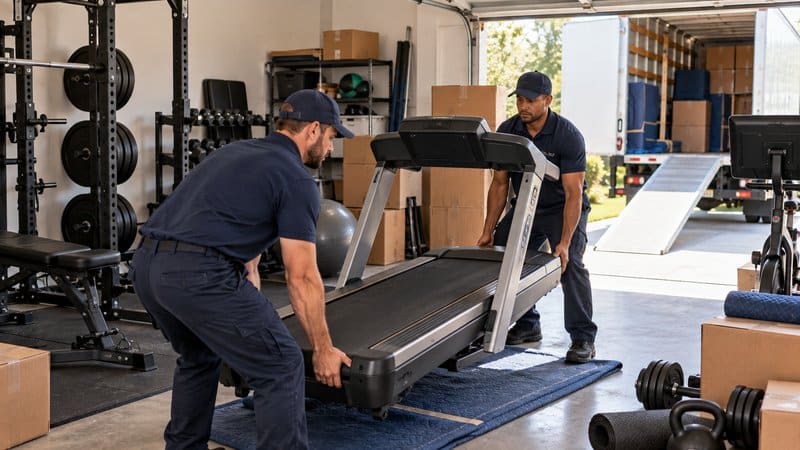
A home gym holds some of the heaviest, most awkward items in an entire house: a fully loaded rack of plates, a treadmill built to stay in one place, a bike with a screen worth more than the frame around it. Moving gym equipment long-distance means all of that has to survive days on the road.
You’re likely worried about getting all your equipment to your new home in one piece, but you don’t have to be. With long-distance full-service movers to help you with proper disassembly and packing choices, you can move all your gym equipment safely across state lines.
Prepare Treadmills, Bikes, and Connected Cardio Equipment
If any of your equipment has digital workout storage, make sure to back up your account and workout data before you disconnect it. Bikes and machines that sync to an app often store history locally as well as in the cloud. This will make for a smooth transition when you’re ready to work out in your new home.
Fold treadmills into their storage position and secure the folding mechanism with the manufacturer’s lock or a strap. You’ll need this to make sure it doesn’t unfold mid-transport, which would be a major safety hazard for anyone near it in the truck.
Remove the console or screen from stationary bikes and treadmills whenever the manufacturer allows it, and pack it separately with extra padding. These screens are usually the most expensive part of the machine, and they’re far more fragile than the steel frame underneath them.
Disconnect power cords, coil them, and tape them to the frame of the machine they belong to. Loose cords can get lost, tangled with another machine’s cord, or caught on another object during loading.
Lower incline treadmills and adjustable machines to their flattest, most compact setting before you move them. Motors and hydraulic lifts sit under less strain in that position. A flat machine is also easier to maneuver through doorways than one stuck at an incline.
Pack Free Weights and Plates the Right Way
Split heavy plates and dumbbells across multiple small boxes instead of one large one. Weight adds up fast, and a single box loaded with 100 pounds of plates isn’t something anyone can lift safely, no matter how sturdy the cardboard is.
Wrap rubber-coated plates and dumbbells individually if they’ll sit near anything that could scuff or dent them, like metal equipment or hard-cornered boxes. Rubber coatings resist wear well during normal use, but they can still tear or peel under the wrong kind of pressure in transit.
Label each box with its approximate weight, not just its contents. A crew member lifting a box that’s labeled “weights” has no way to know if it holds 10 pounds or 90 unless the label tells them. This simple step changes how they carry it.
Pack kettlebells, medicine balls, and other odd-shaped weights on their own, separate from flat plates. Round or irregular shapes roll and shift more than flat ones. Additionally, a box built for stacking plates is only stable if you avoid adding kettlebells or other weights into the mix.
Disassemble Benches and Racks Before You Pack Them
Take pictures of each rack or bench before you start taking it apart, especially pin positions and attachment points. Remove pins, safety bars, and any adjustable attachments. Bag the hardware separately with a label identifying which piece it belongs to. Small parts like these are easy to lose and often impossible to replace individually once you’re in a new city.
Take weight benches down to their basic frame if they were built to come apart, and wrap any padded or upholstered sections separately. Padding tears easily, which means it needs its own layer of protection. Don’t simply rely on a moving blanket wrapped around the whole bench.
Check for welded joints or stress points before moving day, and mention any prior damage to your moving crew. A joint that was already under strain is more likely to fail under a new round of lifting and shifting. Your crew can plan around it if they know in advance.
Protect Flooring and Mats
Roll rubber gym flooring and mats instead of folding them. Folding creates a permanent crease, while rolling keeps the material’s shape intact for reinstallation in your next home.
Number your flooring tiles or sections in the order they came up, especially with interlocking tiles. Reassembling a puzzle of identical black squares is a lot easier with a system than it is by trial and error in a new garage.
Hire a Mover for the Heavy Work
Packing up your home gym is one thing, but actually getting it out of the house, into the moving truck, and unloaded at your new home is another task entirely. Even if you have the physical build for it, moving a home gym can be difficult and dangerous without the right equipment and experience. You could even damage walls or floors if you try moving everything without the proper technique.
The best way to keep your home gym safe and intact is to hire interstate movers. Professional movers have the equipment and experience to handle your gym equipment safely through tight spaces, stairs, and doorways.
Once you arrive, you may need to clear out the garage, install new flooring, or finish renovations before you can unload your gym equipment. In these cases, it can also help to choose a company that offers long-distance moving and storage. Having a storage option gives you somewhere to keep your equipment until the room is ready.
Before moving day, ask your mover about valuation coverage for expensive equipment. If you understand what protection applies to your home gym equipment ahead of time, you’ll have a chance to address any questions before they’re loaded onto the truck.
Set Everything Back Up
Set your large equipment in place before you worry about the rest of the garage or basement. A treadmill and a rack in their spots make the space feel usable again, even while other boxes are still waiting to be unpacked.
Reassemble in the reverse order you took things apart, using the hardware bags and photos you kept along the way. Working backward through your own process is far easier than trying to remember it from scratch weeks later.
Check every bolt and pin for tightness once a rack or bench is back together. Do this before you load a single plate onto it. Equipment that traveled a long distance can settle or shift slightly in transit, and a quick check protects you far more than it costs in time.
Keep Your Gym Equipment Safe
Moving a home gym takes more planning than moving ordinary furniture, but it’s worth doing right. Preparation and help from Colonial Van Lines’ professional movers are what keep your gym equipment, your old home, and your new one safe throughout the moving process. With those details handled, you can spend less time worrying about the move and more time getting your home gym ready for your next workout. Reach out today to start the process of securely moving your home gym.